Thornton Primary School Love • Respect • Ambition
English Curriculum Overview
Our Vision
At Thornton Primary School, we believe that reading, writing and spoken language are at the heart of a successful education. We strive to develop enthusiastic, confident and lifelong readers and writers who can communicate effectively for a wide range of purposes and audiences.
We understand that reading and writing are intrinsically linked. Through exposure to rich, ambitious texts and meaningful writing opportunities, we inspire children to become creative, reflective and skilled communicators. We want every child to leave Thornton Primary with a love of literature, a broad vocabulary and the confidence to express themselves successfully in both spoken and written forms.
Alongside reading and writing, we place a strong emphasis on oracy. We believe that the ability to articulate ideas, listen actively to others and engage in thoughtful discussion is fundamental to learning and future success. Children's speaking and listening skills are developed across the curriculum through collaborative learning, discussion, debate, presentations and purposeful classroom talk.
Intent
Our English curriculum is designed to:
- Foster a love of reading and writing through high-quality, engaging texts.
- Develop confident readers who can understand, analyse and respond thoughtfully to what they read.
- Build children's vocabulary and language knowledge so that they can communicate effectively.
- Enable children to write fluently, accurately and creatively for a range of purposes and audiences.
- Provide meaningful opportunities for children to develop their speaking and listening skills.
- Ensure all children make strong progress from their individual starting points and achieve their full potential.
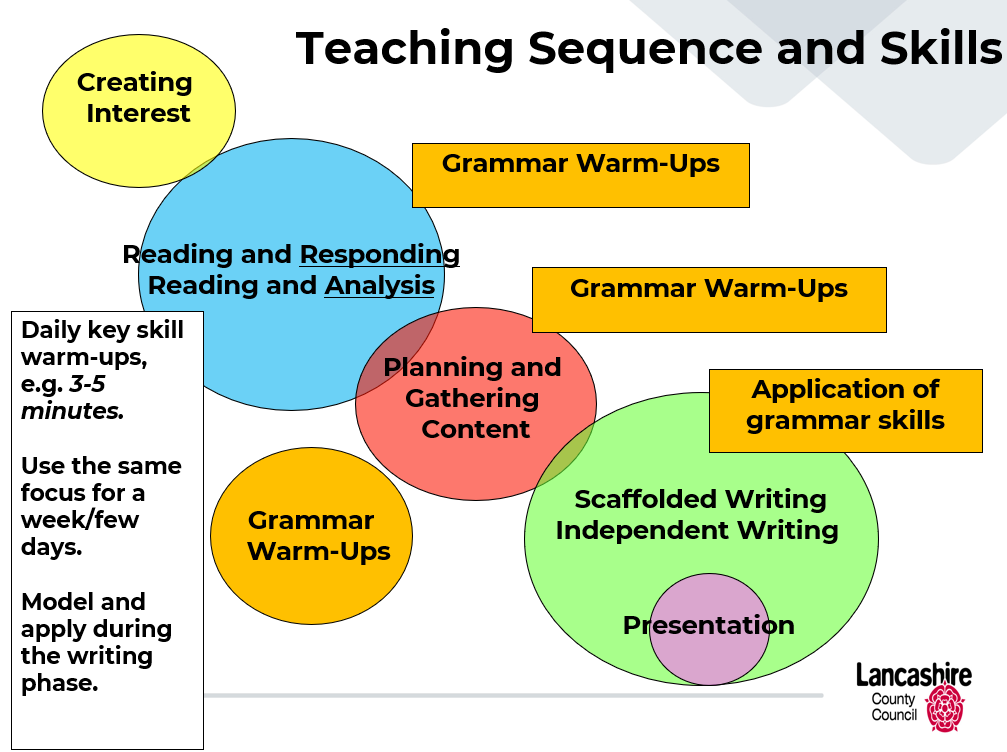
To support this, we use the Lancashire English Planning Scheme, which is built around carefully selected, high-quality texts. These texts provide a rich context for learning and allow children to develop reading comprehension, vocabulary acquisition and writing skills simultaneously.
Implementation
English is taught through the Lancashire English Planning Scheme, which provides a structured sequence of learning that enables children to immerse themselves fully in each text and writing outcome.
Every unit begins with an immersive experience, designed to spark curiosity, generate excitement and provide a meaningful context for learning. This may involve role play, drama, artefacts, videos, practical experiences or discussion activities that engage children from the very start of the unit.
Following this, children work through a sequence of learning which typically includes:
- Reading and responding to the text.
- Exploring themes, characters, language and authorial choices.
- Analysing the structure and features of different text types.
- Developing and expanding vocabulary.
- Gathering ideas and content for writing.
- Planning and drafting their writing.
- Editing and improving their work.
- Producing a final published piece.
Throughout each unit, teachers carefully build in opportunities for independent writing, enabling children to apply the skills they have been taught and demonstrate their growing confidence and understanding.
Oracy at Thornton
Oracy is woven throughout our curriculum and plays a vital role in English lessons and beyond. Children are taught to:
- Speak clearly and confidently.
- Listen actively and respectfully.
- Justify and explain their thinking.
- Build upon the ideas of others.
- Participate in discussion and debate.
- Present their ideas to different audiences.
Teachers provide regular opportunities for partner talk, group discussion, drama activities, hot seating, presentations and collaborative problem-solving. These experiences help children organise their thoughts, deepen their understanding and develop the language needed for successful reading and writing.
Lancashire Planning Circle
Our teaching sequence follows the Lancashire English model, moving children through a cycle of:
Immersion → Reading and Response → Analysis of Text Features → Gathering Content → Planning → Writing → Editing and Publishing
This structured approach ensures children develop a deep understanding of texts before applying their learning in purposeful and high-quality writing outcomes.
Impact
The impact of our English curriculum can be seen in the enthusiasm our children demonstrate for reading, writing and discussion.
Children at Thornton Primary:
- Enjoy reading and engage with a wide range of high-quality texts.
- Develop a rich and ambitious vocabulary.
- Speak confidently and articulately in a variety of situations.
- Write with increasing fluency, accuracy and creativity.
- Understand how to adapt their writing for different purposes and audiences.
- Take pride in their work and strive to improve through reflection and editing.
- Leave Thornton Primary as capable, confident communicators who are well prepared for the next stage of their education.
By the time our children leave us, they possess the knowledge, skills and love of language needed to become successful learners and active participants in the wider world.
Supporting All Learners
At Thornton Primary School, we are committed to ensuring that all children can achieve success in writing. For pupils who experience difficulties with language development, sentence construction or written expression, targeted interventions are provided using the Colourful Semantics approach. This structured, visual framework helps children understand the different components of a sentence by using colour-coded prompts to identify who, what, where and when within a sentence. Through carefully planned intervention sessions, children develop their vocabulary, speaking and listening skills, sentence structure and overall confidence as writers. The approach supports children in organising their ideas effectively and enables them to apply these skills successfully within their classroom writing.
This intervention complements high-quality classroom teaching and helps ensure that all children can access the writing curriculum and make strong progress from their individual starting points.
Spelling
At Thornton Primary School, we recognise that strong spelling skills are essential in enabling children to become confident and effective writers. Our spelling curriculum is carefully structured to build upon the phonics knowledge and understanding developed in Reception and Year 1, ensuring a consistent and progressive approach to language development.
From Year 2 to Year 6, spelling is taught through the Lancashire Red Rose Spelling Programme. As a continuation of the Red Rose Phonics Scheme used in the early years of school, this approach provides coherence and consistency in children's learning, allowing them to build securely on previously taught knowledge and skills.
The Red Rose Spelling Programme supports children in developing a thorough understanding of spelling patterns, rules and conventions. Children learn how words are constructed and explore a range of spelling strategies through engaging and purposeful activities. Lessons focus on:
- National Curriculum spelling rules and patterns.
- Common exception words.
- High-frequency words.
- Morphology and etymology.
- Strategies for applying spelling knowledge within independent writing.
Through regular practice and revisiting of previously taught concepts, children are given multiple opportunities to consolidate and embed their spelling knowledge, enabling them to become increasingly accurate and confident spellers.
To further support learning, the programme is supplemented by Spelling Shed, an interactive online platform that provides additional opportunities for practice both in school and at home. Children access their weekly spelling homework through Spelling Shed, allowing them to revisit and rehearse the words and patterns they have been learning in class. This regular practice helps to strengthen retention and prepare pupils for their weekly spelling assessments.
By combining high-quality teaching through the Lancashire Red Rose Spelling Programme with frequent opportunities for independent practice using Spelling Shed, we aim to develop confident, accurate spellers who can apply their knowledge effectively across all areas of the curriculum.